
Chatgpt
difficulty
Agentic AI: The Rise of Autonomous AI Agents Transforming Business
Discover how Agentic AI and autonomous AI agents are transforming businesses through workflow automation, AI coding assistants, customer support, and intelligent decision-making systems.
M
Muhammad Aamir Yameen
05-25-2026
6 mint read
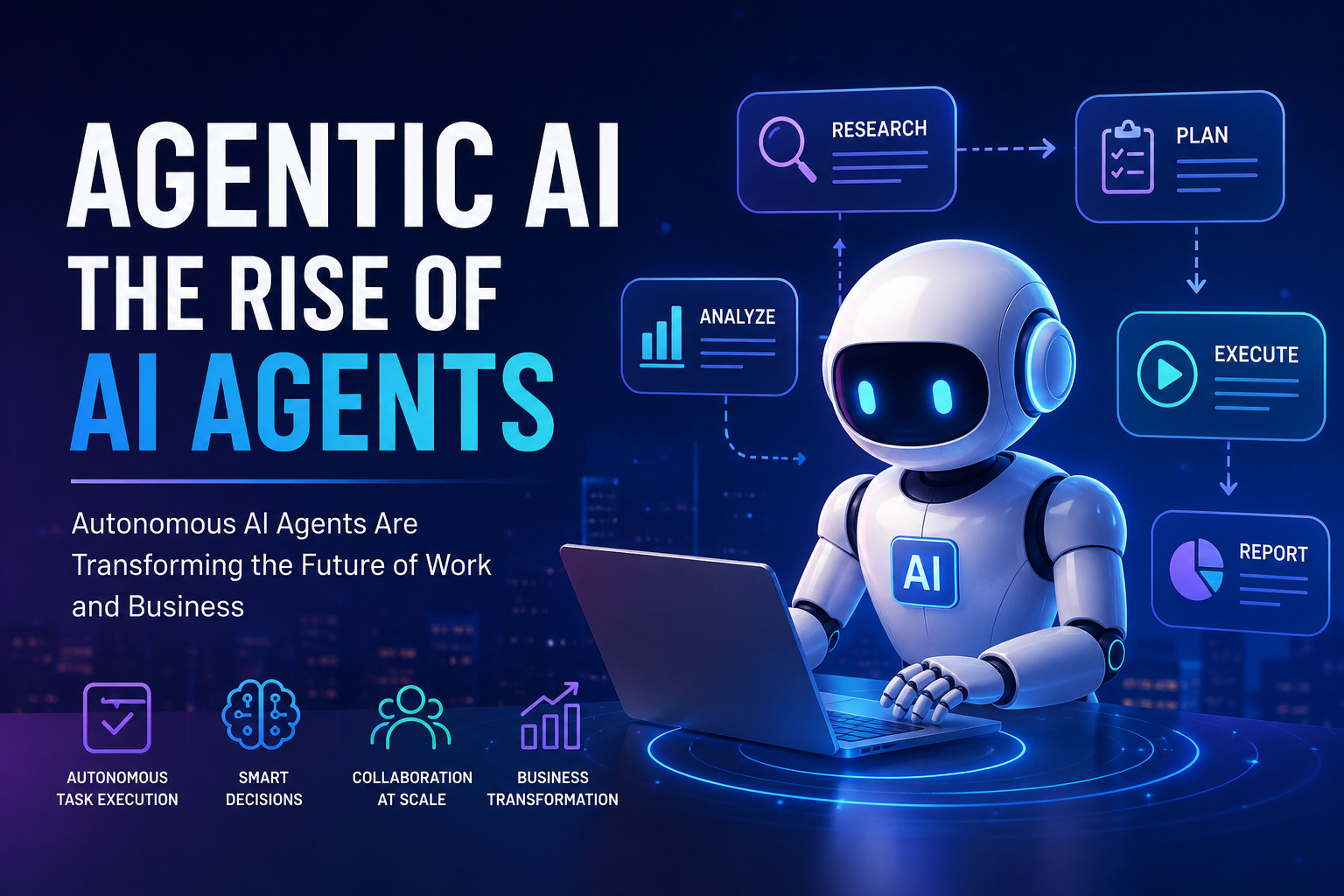
Artificial Intelligence is entering a new era. Traditional AI chatbots that simply answer questions are rapidly evolving into intelligent autonomous systems known as Agentic AI or AI Agents. These systems can think, plan, execute tasks, collaborate with other AI agents, and complete complex workflows with minimal human intervention.
From software development to customer support and business operations, AI agents are becoming digital employees that work 24/7, reduce operational costs, and increase productivity at scale.
Companies across industries are investing heavily in agentic AI because it represents the next major technological shift after generative AI.
What is Agentic AI?
Agentic AI refers to artificial intelligence systems capable of acting autonomously to achieve specific goals. Unlike traditional AI tools that require constant human instructions, AI agents can:
- Understand objectives
- Break tasks into smaller steps
- Make decisions
- Execute workflows
- Learn from outcomes
- Collaborate with other systems
- Adapt in real time
These AI systems function more like intelligent assistants or virtual employees rather than simple chatbots.
For example, instead of asking an AI to “write an email,” you can instruct an AI agent to:
“Handle customer onboarding for new users.”
The agent may then:
- Analyze customer information
- Create personalized emails
- Schedule meetings
- Update CRM systems
- Generate reports
- Notify team members
All automatically.
Why Agentic AI Matters
Agentic AI is one of the biggest trends in technology because it is transforming how businesses operate.
1. AI Can Perform Multi-Step Tasks
Traditional AI tools respond to single prompts. AI agents can execute entire workflows independently.
Examples include:
- Managing customer support tickets
- Automating sales pipelines
- Conducting market research
- Running marketing campaigns
- Writing and testing code
This dramatically increases efficiency.
2. Businesses Are Automating Entire Departments
Organizations are now building AI-powered teams for:
- Customer service
- Operations
- HR
- Finance
- Marketing
- Technical support
- Research
Instead of automating one small task, businesses can automate complete operational processes.
This leads to:
- Reduced operational costs
- Faster execution
- 24/7 productivity
- Better scalability
3. Massive Opportunities for Startups and SaaS Companies
The demand for AI agents is creating huge opportunities for:
- SaaS platforms
- AI automation tools
- Enterprise software
- AI infrastructure companies
- Workflow orchestration systems
Startups are rapidly building specialized AI employees for industries such as healthcare, finance, eCommerce, logistics, and education.
Core Features of AI Agents
Modern AI agents are built with several advanced capabilities.
Autonomous Decision-Making
AI agents can decide what actions to take based on goals and real-time information.
Memory and Context Awareness
Unlike basic chatbots, AI agents remember previous interactions and maintain context across long workflows.
Tool Usage
AI agents can use:
- APIs
- Databases
- Web browsers
- Internal software
- Automation tools
- CRMs
- Communication systems
This allows them to interact with real business environments.
Multi-Agent Collaboration
Multiple AI agents can work together.
For example:
- One agent gathers research
- Another analyzes data
- Another creates reports
- Another communicates results
This creates AI-powered workflows similar to human teams.
Real-World Examples of Agentic AI
AI Coding Assistants
Modern AI coding assistants are becoming highly autonomous.
Popular capabilities include:
- Writing code
- Debugging applications
- Refactoring software
- Running tests
- Deploying applications
- Reviewing pull requests
Examples include:
- GitHub Copilot
- Devin AI
- Cursor AI
- OpenAI Codex-based systems
These tools significantly accelerate software development.
AI Customer Support Agents
AI customer service agents can:
- Handle support tickets
- Answer customer questions
- Resolve common issues
- Escalate complex problems
- Process refunds
- Update account information
Businesses are using AI agents to provide instant 24/7 support while reducing support costs.
AI Research Assistants
AI research agents can:
- Search the web
- Summarize documents
- Analyze competitors
- Extract insights
- Generate reports
- Monitor industry trends
These systems are becoming powerful tools for researchers, analysts, and business teams.
Autonomous Workflow Automation
AI agents are increasingly integrated into business operations to automate workflows such as:
- Invoice processing
- Employee onboarding
- Lead qualification
- Data entry
- Meeting scheduling
- CRM updates
- Sales outreach
This reduces repetitive manual work and improves operational efficiency.
How Agentic AI Works
Agentic AI systems typically combine several technologies together.
Large Language Models (LLMs)
LLMs provide reasoning, communication, and understanding capabilities.
Examples include:
- GPT models
- Claude
- Gemini
- Llama
Planning Systems
Planning frameworks allow AI agents to:
- Break objectives into tasks
- Prioritize actions
- Create execution strategies
Memory Systems
Memory enables agents to retain:
- User preferences
- Historical interactions
- Workflow progress
- Business context
Tool Integration
AI agents connect with external systems using APIs and automation platforms.
Examples:
- Slack
- Salesforce
- HubSpot
- Google Workspace
- Jira
- GitHub
Industries Being Transformed by AI Agents
Healthcare
AI agents assist with:
- Patient scheduling
- Medical documentation
- Healthcare analytics
- Virtual assistance
Finance
Financial AI agents help with:
- Fraud detection
- Investment analysis
- Automated reporting
- Customer service
eCommerce
AI agents improve:
- Product recommendations
- Inventory management
- Customer engagement
- Order support
Software Development
Development teams use AI agents for:
- Code generation
- Testing
- Deployment automation
- Technical documentation
Benefits of Agentic AI
Increased Productivity
AI agents work continuously without fatigue.
Reduced Costs
Businesses can automate repetitive workflows and reduce manual labor expenses.
Faster Decision-Making
AI systems analyze large amounts of data instantly.
Scalability
Organizations can scale operations without rapidly increasing workforce size.
Challenges and Risks
Despite its advantages, Agentic AI also introduces challenges.
Security Risks
Autonomous systems accessing business tools and data require strong security controls.
Reliability Concerns
AI agents can still make mistakes or hallucinate incorrect information.
Ethical Considerations
Businesses must ensure transparency, fairness, and responsible AI usage.
Human Oversight
Most organizations still require humans to supervise critical decisions.
The Future of Agentic AI
The future of AI is moving toward highly collaborative intelligent systems.
Experts predict:
- AI employees will become common in businesses
- Multi-agent systems will manage complex operations
- AI-powered companies will operate with smaller teams
- Human workers will increasingly collaborate with AI systems
In the coming years, Agentic AI may become as important as cloud computing and mobile technology were during previous technological revolutions.
Final Thoughts
Agentic AI is reshaping the future of work and business automation. These intelligent AI agents are evolving beyond simple chatbots into autonomous digital workers capable of handling complex tasks, making decisions, and collaborating across workflows.
For startups, enterprises, and SaaS companies, this presents enormous opportunities to build smarter products, automate operations, and create entirely new business models.
As AI technology continues advancing, organizations that adopt AI agents early may gain a significant competitive advantage in the rapidly evolving digital economy.
Need this built for your business?
Turn this into a real solution
We build AI systems, SaaS platforms, mobile apps & custom software. Let's discuss your project — free consultation.
M
Muhammad Aamir Yameen
Software Engineer
Need this built?
We build AI systems, SaaS platforms, mobile apps & automation. Free consultation.