
difficulty
Will ai replace programmers?
Will AI replace programmers? Discover the truth about AI's impact on coding jobs, essential skills for 2025, and why human developers remain irreplaceable.
M
Muhammad Aamir Yameen
10-27-2025
9 mint read
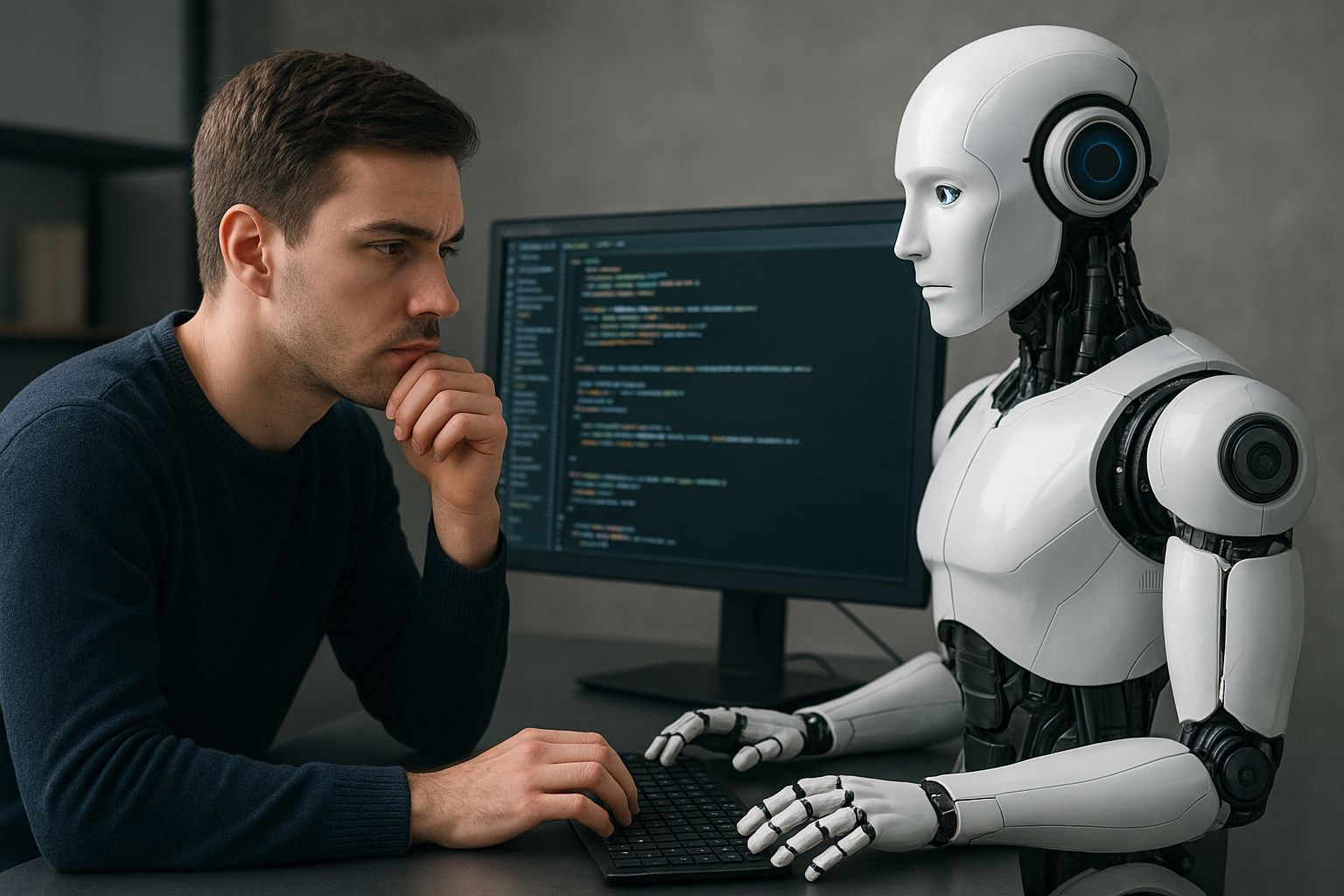
Introduction: Understanding AI and the Programming Debate
Will AI replace programmers? This question is dominating the tech conversation through 2024 and 2025. As artificial intelligence continues to evolve at an unprecedented pace, many aspiring developers and experienced professionals are wondering about the future of their careers. The short answer is: No, AI won't completely replace programmers – but it will fundamentally change the way they work.The relationship between AI and programming is more subtle than simple replacement. AI will not replace programmers, but will fundamentally change the development landscape, making human creativity and problem-solving essential. Think of it as evolution instead of extinction.In this comprehensive guide, we'll explore why whether AI will replace programmers remains a hot topic, examine real-world evidence, and explore how developers can move forward alongside AI technology.
Current Situation: Will AI replace programmers in 2025?
What the research really shows
Given current views, it is unlikely that AI will completely replace developers by 2025. However, the impact is significant and requires attention.Recent studies from the US Department of Energy's Oak Ridge National Laboratory suggest that AI could potentially replace some programming tasks by 2040. But this timeline continues to change as we better understand the limitations of AI.Key statistics:
- The U.S. Bureau of Labor Statistics estimates that employment in computer and information technology occupations will grow much faster than average from 2023 to 2033, with approximately 356,700 jobs projected to open each year.
- WorldMetrics predicts 540,000 new software engineering jobs in 2025
- Nearly 30% of developers surveyed are worried about AI displacement
These numbers tell a compelling story: Whether AI will replace programmers isn't resulting in jobs being lost — it's driving change.
What industry leaders say
Microsoft CEO Satya Nadella says: "AI won't replace programmers, but it will become an essential tool in their arsenal. It's about empowering humans to do more, not less".Senior developers emphasize that AI tools, if used to replace software engineers in any capacity, will be used to perform entry-level work, but should be overseen by experienced professionals.
Understanding AI technologies impacting programming
AI vs ML vs DL: What's the difference?
Before answering whetherAIwill replace programmers, we need to understand the technologies involved:Artificial intelligence (AI)is the broad concept of machines performing tasks that typically require human intelligence. This includes everything from simple automation to complex decision making.Machine learning (ML) is a subset of AIwhere systems learn from data without explicit programming. ML algorithms power code suggestion and pattern recognition in development tools.Deep learning (DL)is a specialized subset of ML using neural networks to process complex patterns. DL operates advanced coding assistants and natural language processing tools.
The birth of modern AI in programming
The journey from early computing to modern AIcoding assistants represents decades of evolution. The birth of modern AI in software development began with simple autocomplete features and evolved into sophisticated tools like GitHub Copilot and Cloud AI.Early predictions about automation replacing programmers were in 1965, when Herbert Simon predicted that machines could do "any job a man can do" within 20 years. His predictions about programming were extremely wrong - at the time when machines were to replace humans, the number of programmers increased two to five times.
AI models and tools transformative development
GitHub Copilot vs. Cloud AI: The New Developer Assistant
When examining whether AI will replace programmers, we should focus on the key AI tools:GitHub Copilot uses OpenAI's Codex to suggest code completion. It is excellent for boilerplate code and common patterns but has significant limitations. GitHub Copilot hallucinates methods and properties that don't exist, and the generated code doesn't always compile without manual work.Copilot vs cloudrepresents different approaches. Cloud AI focuses on conversational assistance and understanding context, while Copilot integrates directly into code editors.Both tools enhance rather than replace developers. The popular phrase “AI will not replace developers, but developers using AI” reflects today's reality.
Chatbot technology in development
AIchatbotassistants have revolutionized the way developers get help. ChatGPT has also overtaken StackOverflow as a resource for many programmers.Chatbots provide tools to:quick code explanation
- debugging tips
- architectural recommendations
- learning resources
However, Talkie AIand similar conversation tools work best for educational purposes and simple questions. They grapple with complex, context-heavy problems that require deep understanding.
NSFW AI Chatbots and Ethical Considerations
The proliferation ofNSFW AI chatbotshighlights important ethical discussions around AI development. These tools demonstrate the capabilities of AI while raising concerns about appropriate use cases.Professional developers must consider the ethical implications when building or using AI systems. The question of whether AI will replace programmers also includes consideration of what kind of software we want AI to create.
Why won't AI completely replace programmers?
Creativity factor
Programming isn't just about writing syntax – it's about solving problems creatively. Software engineering involves solving complex problems, designing algorithms, and developing complex systems that still require human expertise to conceptualize, architect, and design solutions that meet specific needs.Think about building a Victorian houseversus assembling prefab walls. AI can help with prefab parts (common code patterns), but architectural vision, custom details, and problem-solving require human insight.
Skills AI can't replicate
Human developers excel at:Understanding unclear business requirements
- strategic architectural decision making
- Debugging complex system interactions
- Considering edge cases and security implications
- Team support and guidance
- making ethical decisions
- creative problem-solving
AI modelsdo not have the capacity for creative thought – they are productive rather than creative.
Abstract ladder
Technology has always been climbing the stairs of abstraction. We moved from assembly language to C, Python, and frameworks. AI represents another rung on this ladder—not a replacement for the rung.Developers have always used tools to work more efficiently. The latest, most powerful tool in the AI toolkit.
How is AI really changing programming?
Increase productivity
Companies report 30% productivity increases from AI tools. This doesn't mean replacing the programmer; This means they achieve more.AI excels at:Generating Boilerplate Code
- typing test
- documentation
- code refactoring
- finding common bugs
- Interpreting Code Snippets
New job requirements
Instead of asking whether AI will replace programmers, we should ask: “How will programming jobs evolve?”Emerging roles include:
- AI tools expert
- speedy engineers
- AI System Architects
- ml ops engineer
AI ethics consultant
Junior Developer Challenge
If companies replace lower level positions with AI it will become harder to enter the industry, as there will be no experience at the lower level in 5-10 years.This presents a paradox: Companies want experienced developers who can oversee AI, but fewer junior positions mean fewer people are getting that experience.
Essential skills for programmers in the AI age
Technical skills that matter
When asking whether AI will replace programmers, focus on these to move forward:1. Problem-solving skillsUnderstanding the problems deeply is irreplaceable. AI generates solutions, but humans must evaluate their suitability.2. System DesignLarge-scale architecture requires understanding trade-offs, performance, and business requirements—areas where AI struggles.3. AI Tool IntegrationLearning to use AI coding assistants effectively increases productivity dramatically.4. Security AwarenessAI models produce code full of bugs and security vulnerabilities. Human supervision is important.
Soft skills are becoming more important
As AI takes over routine tasks, human skills become the differentiator:
- Communication: Explaining Technical Concepts
- Leadership: Guiding teams and projects
Critical Thinking: Evaluating AI-Generated Solutions
- Adaptability: Learning new tools quickly
- Creativity: Solving Unique Problems
Investment and Market Perspective
Technology stock implications
Platforms like 5starsstocks.comanalyze how AI impacts tech company valuations. AI revolution creates winners and losers in the stock market.Companies that successfully integrate AI rise in valuations, while companies that lag behind struggle. For investors, understanding whether AI will replace programmers helps evaluate tech stock potential.
Preparing for the Future: Actionable Steps
For aspiring programmers
If you're wondering whether AI will replace programmers before you even start your career, take heart. Bill Gates and Andrew Ng explain why it's more important than ever to learn to code.Steps to be taken:
- Learn the basics well – don't skip the basics by relying on AI
- Practice problem-solving – focus on thinking, not just syntax
- Create real projects – practical experience is irreplaceable
- Use AI as a teaching tool – let it explain concepts, don't just copy code
- Develop soft skills – communication and collaboration matter more than ever
For experienced developers
Stay relevant by:
- Experimenting with AI tools – understand their capabilities and limitations
- Focusing on architecture – high-level design remains human-centric
- Mentoring others – sharing knowledge and developing leadership skills
- Strategically specialize – develop expertise that AI cannot replicate
- Building AI Literacy – Understand How These Systems Work
Frequently Asked Questions (FAQ)
1. Will AI replace programmers in the next 5-10 years?
No, AI will not replace programmers within the next 5-10 years. While AI development will have a significant impact on the profession, complete replacement is unlikely. Job market data shows that programming positions continue to have strong growth, with the US Bureau of Labor Statistics projecting faster than average growth through 2033. However, the nature of programming work will evolve, with AI handling routine tasks while humans will focus on complex problem-solving, architecture, and creative solutions.
2. If AI is getting better at coding should I still learn programming?
Absolutely! Tech leaders including Bill Gates and Andrew Ng highlight why learning to code is more important than ever as AI tools continue to make coding easier. Learning to code teaches problem-solving, logical thinking, and systems understanding – skills that remain valuable despite AI advancements. Additionally, using AI coding tools effectively requires programming knowledge. The question is not whether one should learn programming or not, but rather how to learn it effectively along with AI tools. Whether AI will replace programmers remains a question of transformation, not abolition.
3. What programming skills should I focus on in the AI age?
Focus on skills that AI can't easily replicate: soft skills like systems design and architecture, complex problem-solving, security and quality assurance, AI tool integration, and communication and leadership. Human expertise is required to conceptualize, architect, and design complex software solutions that meet specific needs. Additionally, develop expertise in areas requiring deep domain knowledge, such as health care systems, financial infrastructure, or embedded systems. how to understand
Conclusion: Embracing an AI-augmented future
The question of whether AI will replace programmers has given rise to necessary conversations about the future of software development. Evidence shows that while AI will replace programming work, human developers will remain essential.Further routes include:Adopting AI as a Powerful Productivity Tool
- Focusing on specific human skills
- Continuous learning and adaptation
- Creating systems that leverage both AI capabilities and human insight
- Maintaining ethical standards in AI-assisted development
Instead of fearing obsolescence, developers should see it as an opportunity. Those who learn to work effectively with AI tools while developing irreplaceable human skills will succeed in the emerging technological landscape.Will AI replace programmers? Not completely – but it will create better, more productive, and more creative developers who will leverage AI to build the next generation of transformative software.
Need this built for your business?
Turn this into a real solution
We build AI systems, SaaS platforms, mobile apps & custom software. Let's discuss your project — free consultation.
M
Muhammad Aamir Yameen
Software Engineer
Need this built?
We build AI systems, SaaS platforms, mobile apps & automation. Free consultation.